How an obstruction of justice case may be shaping up against Trump
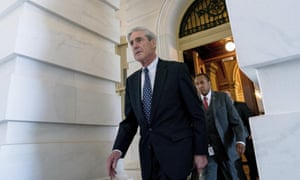
Two of the most intriguing questions in US national political discourse – what does the special counsel Robert Mueller have on Donald Trump, and what more is he looking for? – were filled in at a remarkable pace this week, as details of highly sensitive documents and internal Trump Organization emails became public for the first time.
Taken together, the documents could indicate that the special counsel is looking seriously at whether Trump committed an obstruction of justice on potentially various fronts, legal experts say.
Certain additional documents whose existence was revealed for the first time – meeting notes taken by the former Trump campaign chairman Paul Manafort, and a letter of intent reportedly signed by Trump to build a tower in Moscow – seemed to undercut previous statements by the president, his son and others about relationships now under the scrutiny of Mueller’s team.
Mueller is charged with investigating alleged ties between the Trump presidential campaign and Russian operatives, and he is believed to be examining the past financial relationships of Trump, Manafort and others.
Obstruction?
The Wall Street Journal revealed this week that Trump lawyers had submitted memos to Mueller arguing that the president did not obstruct justice by firing the former FBI director James Comey. Those memos were probably not written in a vacuum, said Renato Mariotti, a former federal prosecutor and legal commentator.
“One important implication that you can draw from the fact that they sent the memo is that they believe that Mueller is seriously looking at obstruction,” Mariotti said. “They would not send that memo otherwise.”
In any obstruction of justice case against Trump, Mueller might also review reports from this week that Trump had directly contacted the chairman of the Senate judiciary committee after it was announced that Trump’s son, Donald Trump Jr, was scheduled to speak with the committee, said Mariotti.
Mueller might additionally review this week’s report that before pardoning the Arizona sheriff Joe Arpaio, Trump asked the US attorney general, Jeff Sessions, whether it would be possible to drop federal criminal charges against Arpaio.
“I think that all goes into the same bucket of things that could be used by Mueller if he’s looking at obstruction of justice,” said Mariotti.
Draft letter
The documents were still flowing on Friday afternoon, with a New York Times report that Mueller was in possession of a draft letter explaining Trump’s rationale for firing Comey. The draft was reportedly written by Trump and an aide, Stephen Miller, but rejected by the White House counsel, on unknown grounds.
Trump has said he fired Comey while experiencing frustration at the FBI investigation of his campaign’s alleged Russia ties and at Comey’s refusal to publicly exculpate Trump. The firing ironically hastened the appointment of a special counsel, under whom the investigation has expanded.
Former US attorneys judged the draft letter and its possession by Mueller as significant. “Logical assumption: If WH Counsel wouldn’t let him send it, [Trump] had improper if not illegal motives for firing FBI Director Comey,” wrote Joyce Vance, a former federal prosecutor in Birmingham, Alabama, and now a University of Alabama law professor.
“Hard to assess significance without knowing the actual contents of the draft firing letter and why WH counsel vetoed it. But can’t be good,” wrotePreet Bharara, the former US attorney for the southern district of New York and now a professor at New York University’s law school.
Ryan Goodman, a former special counsel at the defense department, tweeted that a “big implication” of the draft letter’s existence was that Miller, the aide who helped Trump draft the letter, is “perhaps implicated in conspiracy to obstruct justice”.
Other documents revealed a changing narrative in Trump campaign contacts with Russian agents. The Washington Post reported Monday that during the campaign, Trump’s lawyer Michael Cohen wrote an email to an aide to Russia’s president, Vladimir Putin, asking for help with a real estate deal.
It was further revealed that early on in the presidential campaign, Trump signed a non-binding letter of intent to build a tower in Moscow, Cohen confirmed in a statement to ABC News. Trump claimed during the campaign that he “knows nothing about Russia” and had “no loans” and “no deals” there.
In a separate incident, Manafort took notes, since obtained by Mueller, about a June 2016 meeting at Trump Tower arranged by Trump Jr, who expressed eagerness to receive damaging information about Hillary Clinton, NBC News reported on Friday.
Manafort’s notes reportedly referred to political contributions and to the “RNC”, or Republican National Committee. The president personally dictated a statement released by Trump Jr saying the meeting “primarily discussed a program about the adoption of Russian children”, the Washington Post reported in July.
The details of any Trump deal or debt with a Russian connection, if any exist, are not publicly known – but yet another headline this week indicated that Mueller may have gained insight on the subject. According to a Daily Beast report on Thursday, the special counsel has enlisted the help of agents from the criminal investigation unit of the Internal Revenue Service.
“I think he got everybody’s tax returns,” said Mariotti, now a defense attorney at Thompson Coburn in Chicago. “I have no professional, personal knowledge of it, but when you’re looking at someone for something unrelated to taxes, still to get tax return information is very valuable information that tells you a lot of valuable things: who owes them money, who they owe money to, and where they keep their money.”
Since you’re here …
… we have a small favour to ask. More people are reading the Guardian than ever but advertising revenues across the media are falling fast. And unlike many news organisations, we haven’t put up a paywall – we want to keep our journalism as open as we can. So you can see why we need to ask for your help. The Guardian’s independent, investigative journalism takes a lot of time, money and hard work to produce. But we do it because we believe our perspective matters – because it might well be your perspective, too.
I appreciate there not being a paywall: it is more democratic for the media to be available for all and not a commodity to be purchased by a few. I’m happy to make a contribution so others with less means still have access to information.Thomasine F-R.
If everyone who reads our reporting, who likes it, helps to support it, our future would be much more secure.


Comments
Post a Comment